

There are two ways a startup can get focus wrong, and only one of them shows. Explore too much and you fail where everyone can see it: nothing valuable gets finished, and a more focused competitor beats you. Focus too much and you fail where almost nobody sees it, including you.
The first failure is why the best-known startup advice is to focus.1 I believe most of it. (I’ve said a version of it myself: target a very specific niche, truly dominate it, and use it as a beachhead to expand.) But the second failure comes from your progress. Every step up the hill opens new paths, and some of them are better than the one you’re on. Focus is what keeps you from looking at them.
So good startups also explore. Evolution faces the same trade-off, between working what it has found and searching for something better. I think of it as looking for gold in a mountain range, with two kinds of people doing two kinds of work. Scouts prospect new ground before anyone can prove it’s worth it. Diggers work the ground you’ve already found. Good startups shift people between the two long after they find product-market fit, and each new dig starts on wider ground than the last.
When should you pull people off digging and send them scouting? And how would you know?
Mostly by pace. Bringing up more gold every month isn’t enough, because you can grow every month and still be going slowly. What matters is whether the digging keeps speeding up. The rest is intuition and feel: is this the big mine, or scraps from a pocket that will run out soon?
Mashgin, the computer-vision checkout company I joined in 2015, started out exploring. A few years earlier, deep learning had made computer vision far more general than the methods before it, and a wave of startups set out to use it. We were ambitious too. While the founders were going through YC, Paul Graham agreed: Mashgin should think big. We weren’t a checkout company, we were a computer vision company. Nearly all of our early experiments came to us inbound, from manufacturers and others asking if our vision tech could solve their problem. Before product-market fit it’s easy to say yes, because you’ll take fit anywhere.
Manufacturing looked like the best bet: a huge market, with big contracts paid up front. One of our founders and I went to Mexico to tour factories, and there I pitched a Nike executive on how much better our tech would be at quality control for shoes and apparel.
During our Series A raise in 2017 we decided to focus only on checkout and end the other projects. The raise was a good forcing function, and we needed one. Walking away from manufacturing was hard at first, but checkout had strong signs of demand and a potential big contract with Aramark. We had also been confident we could make one general solution for every industry that called us. In hindsight, that was pure engineering thinking. The tech wasn’t good enough yet to sell as a component, so every market needed its own product, sales team, and industry knowledge. We could only afford one.
This is the part the focus advice gets right. We could commit to checkout only because we’d already walked a little way down the other paths and seen what was there.
But the digging didn’t end the cycle. In 2018 and 2019 we filled out the checkout product for business dining, and customers were pulling it from us. It was working, just not fast. Business dining was hard to scale for the same reason it was a good early adopter: every location was like a small-business restaurant, with its own features and integrations to add. We were growing, but it was painful.
So we sent scouts out again. This time they weren’t looking for a problem to solve but for customers to serve.
Sports came through Aramark, since the same companies that run business dining often run stadiums too. The first pilot totally failed. A concession stand is set up for order, pay, then get your food, and our checkout works the other way around. But Aramark saw so much potential in the speed that we kept at it until both sides adapted. Sports is a smaller market, but the fit was extremely strong, because at a stadium, speed is sales. Fans would rather be in their seats, and the stand has more demand than its lines can handle, so doubling the speed of the line doubles sales in many cases.
We would not have found that if we had just focused heads-down on adding functionality and making it perfect in business dining.
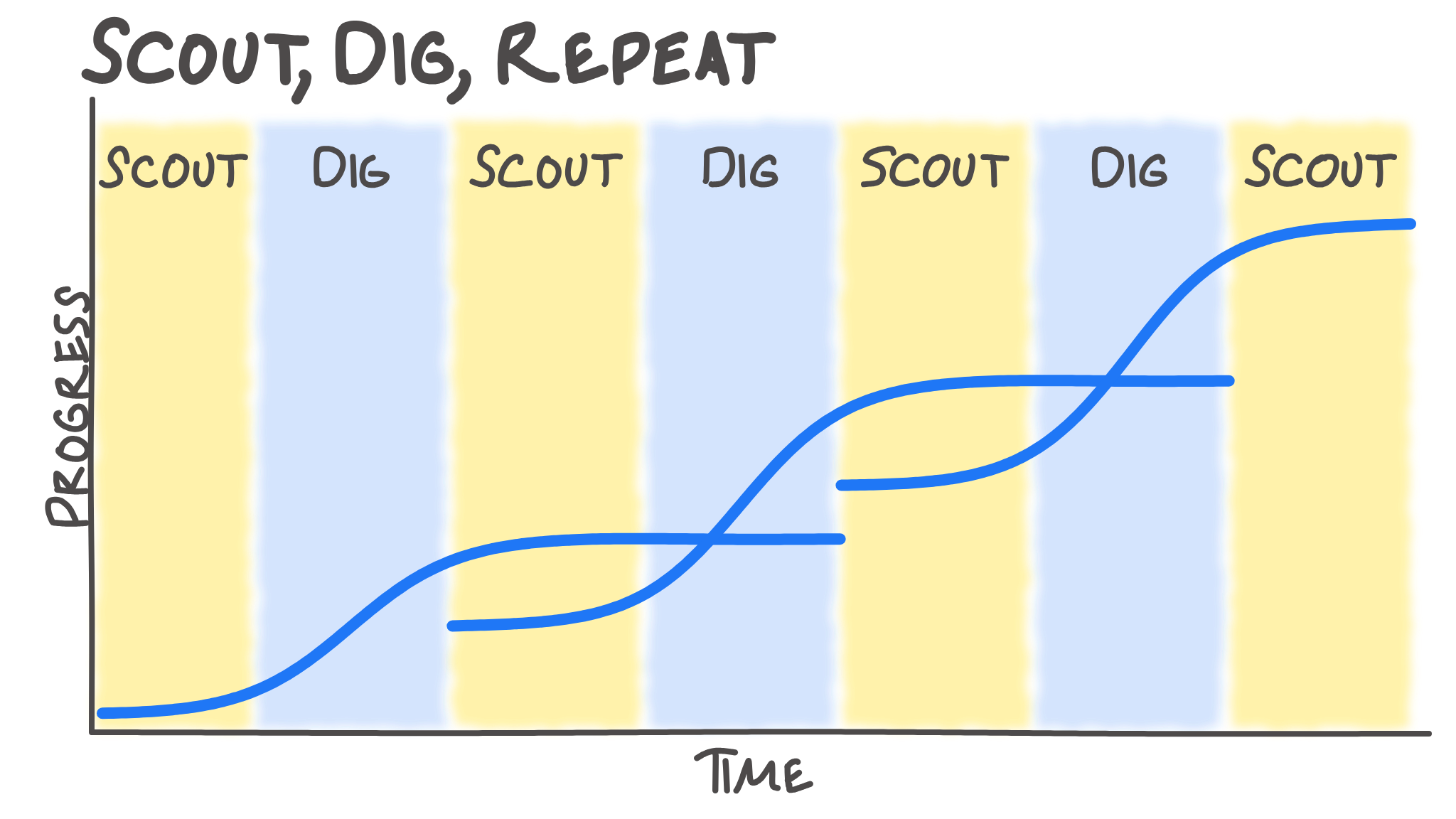
Business dining had gold in it, but the pace never picked up. That made our call easy: the market told us to look.
The hard call is when your diggers are bringing gold up fast. Paul Graham makes the best case for staying put. A startup that climbs toward a weekly growth number “could end up on a local maximum,” he wrote in 2012. “But in practice that never happens.” His reason: “Most fairly good ideas are adjacent to even better ones.”
I agree the better idea is usually next door. But you only find it if you look up, and a weekly growth number doesn’t pay you for a step sideways. When the digging is going well, nobody looks up.
Look at Intel in 2006. Its x86 business was working. Apple had just moved the Mac to Intel chips, so Apple was already a customer. Intel also owned XScale, a line of mobile chips with RIM and Palm among its buyers. In June 2006 Intel sold XScale to Marvell for $600 million, to “focus its investments on its core businesses.” About seven months later, Apple announced the iPhone.
Apple had wanted an Intel chip for it. But Apple’s price was below Intel’s forecasted cost, so CEO Paul Otellini said no. A digger’s spreadsheet killed a scout’s opportunity. In his last month on the job in 2013, he admitted “I couldn’t see it,” and said “the volume was 100x what anyone thought.”
Nothing at Intel was broken.
Digging harder into x86 wasn’t the mistake, since with that much gold coming up you should dig. The mistake was selling the claim next door, the one Intel’s position had handed it. Most of the company can keep digging while a few scouts stay out. (How to set that up is another essay, but it’s the leader’s job.) Intel had the profits to do both.
Microsoft kept its side claim. In 1989 DOS had 66% of the market, so Microsoft was already winning, while OS/2, its main bet, had under 1%. Windows was a side bet, “not our prime focus,” in the words of Gordon Letwin, Microsoft’s lead OS/2 architect. Then Windows 3.0 shipped in 1990 and took off, and IBM told Microsoft to stop developing Windows or lose OS/2. Letwin: “It seemed just stupid to us to kill a healthy animal in the hopes of nursing a sick one into recovery!” A year later Gates wrote that “our strategy for the 90’s is Windows.” The scouts had become the diggers, and by the end of the decade a federal court found that Microsoft had a monopoly on PC operating systems.
You could fairly ask whether I picked these two because I know how they ended. Partly, yes, and Microsoft’s portfolio was half strategy and half accident. That’s fine! The part that wasn’t luck was a choice: when IBM demanded it kill a side bet that was working, Microsoft refused. Intel sold its side bet without anyone asking.
Both were winning, and they chose opposite ways. That’s why winning or losing isn’t the signal. A struggling company with gold still under it should put everyone on digging, and one standing on scraps should send everyone scouting, or start over. For everyone in between, it comes back to pace. While the digging keeps speeding up, dig harder, and keep a few scouts out anyway, which is the part Intel skipped. Once it slows, start moving people from digging to scouting while the find still pays for it.
The chart makes this look cleaner than it is. It’s not like everyone digs this quarter and scouts the next. In practice you always have some of both. But there are still rough phases. You lean toward digging while things keep getting better and you’re pulling more and more value out of the product, and you lean toward scouting when that tapers off. Often you can’t tell which one you’re in until later. Business dining looked like it was working, and sports started with a failed pilot.
If you can’t tell which phase you’re in, don’t bet everything on one answer. Every mine runs out, and evolution’s answer, four billion years running, is to keep a few scouts in the hills. Startups get the opposite advice. Everyone warns founders about doing too many things. Almost nobody warns them about doing one thing for too long.
Sam Altman recently said the pick-one advice “was correct two years ago,” because now “you can build all 30 things.” AI makes scouting cheaper. It doesn’t make digging optional.